
Google first showed a DoctorDirectory.ai page in its search results on September 21, 2026. Six weeks later, 1,723 of our doctor profile pages are on the first page of Google. And most of it happened in the last two weeks, after we opened every doctor profile to Google. We are proud of that number, and we want to show you exactly how we got there.
This is not luck, and it is not a trick. It is what happens when you put the right research, the right structure, the right markup, and steady marketing behind a site that patients can actually trust.
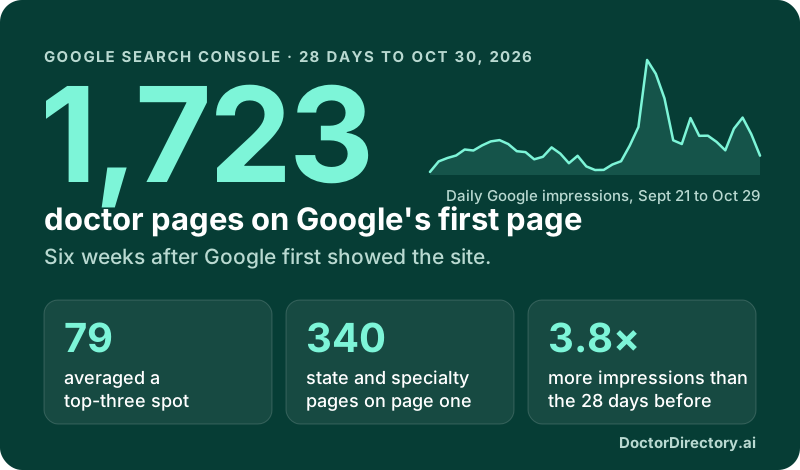
The numbers, straight from Google Search Console
Google Search Console is Google's own report on how a site shows up in search. Here is what it showed for the 28 days ending October 30, 2026:
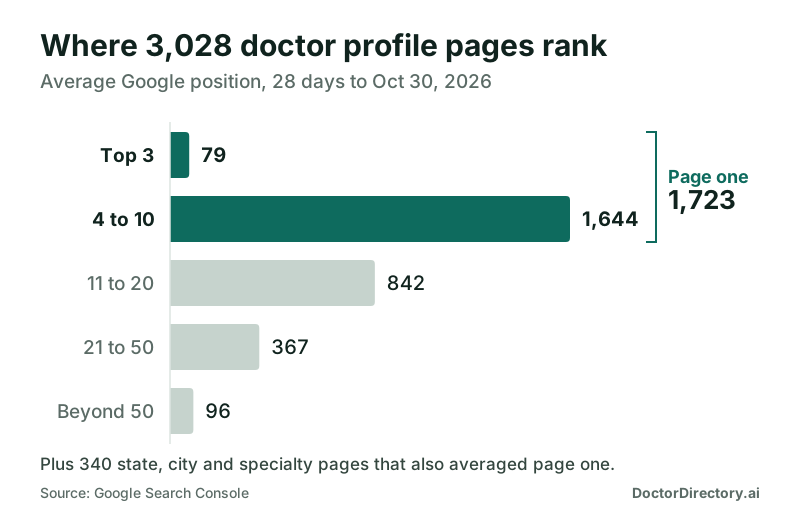
- 3,819 pages on DoctorDirectory.ai appeared in Google results. 3,028 of them were doctor profile pages.
- 1,723 doctor profile pages had an average position on the first page of Google, meaning position 10 or better.
- 79 profile pages averaged a top-three position, and 27 averaged about number one.
- 340 more pages, such as our state and specialty pages, also averaged the first page. Our page for cholesterol doctors in Nebraska averaged number one.
- Google impressions grew 3.8 times compared with the 28 days before.
An impression is one time a page showed up in someone's search results. Average position is where the page tended to appear. Most of the first-page searches we can see are searches for a doctor's own name, which is exactly when a patient is deciding whether to book.
The week it took off
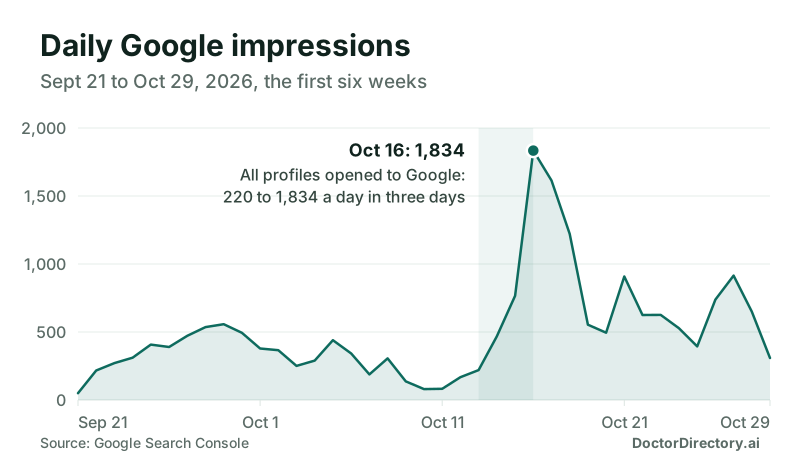
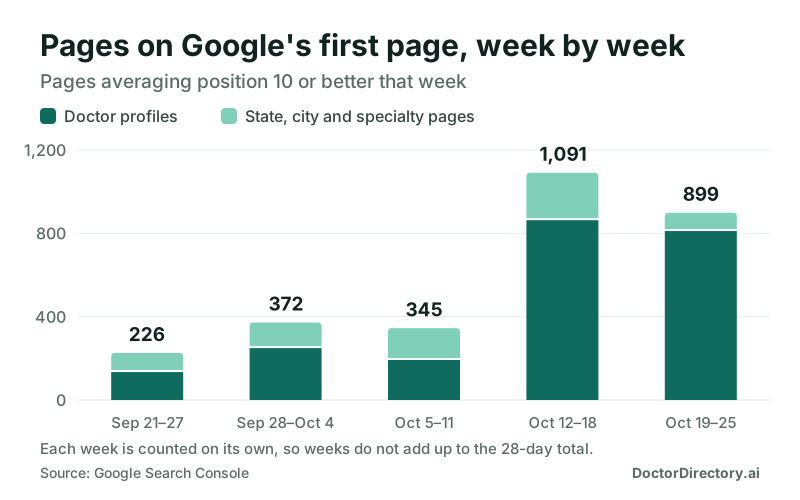
In mid-October, we opened every doctor profile on the site to Google and listed them in our sitemaps. Daily impressions went from 220 on October 13 to 1,834 on October 16. That is more than eight times as many in three days.
Here is the part that surprised even us. In the two weeks after every profile opened to Google, from October 16 to 30, 1,509 doctor profile pages averaged a first-page position. In the two weeks before, from October 2 to 15, it was 508. That is three times as many in the same amount of time. The site has been on Google for six weeks, but most of these first-page results came in about two.
A sitemap is a list that tells Google which pages exist. Ours is split into files of 45,000 profiles each, so Google can read all of them without getting lost.
Why the older directories have not caught up
Some doctor directories have been online for 15 to 20 years. In internet years, that makes them dinosaurs. A site built in 2008 was built for the Google of 2008.
Google has changed a lot since then. Today it reads structured data to learn who a doctor is, where they practice, and what they treat. It favors pages that load fast on a phone. It holds health pages to a higher standard of trust. And it rewards sites that keep adding useful pages, written in the words patients use now.
Keeping up means rebuilding. Rebuilding a huge site on an old platform and an old database is slow, costly, and risky. Few teams know how to use the newest tools well. And when a site already makes good money the way it is, there is little reason to change. So many older sites stay as they are.
That left an opening. We built DoctorDirectory.ai for the Google of 2027 from day one.
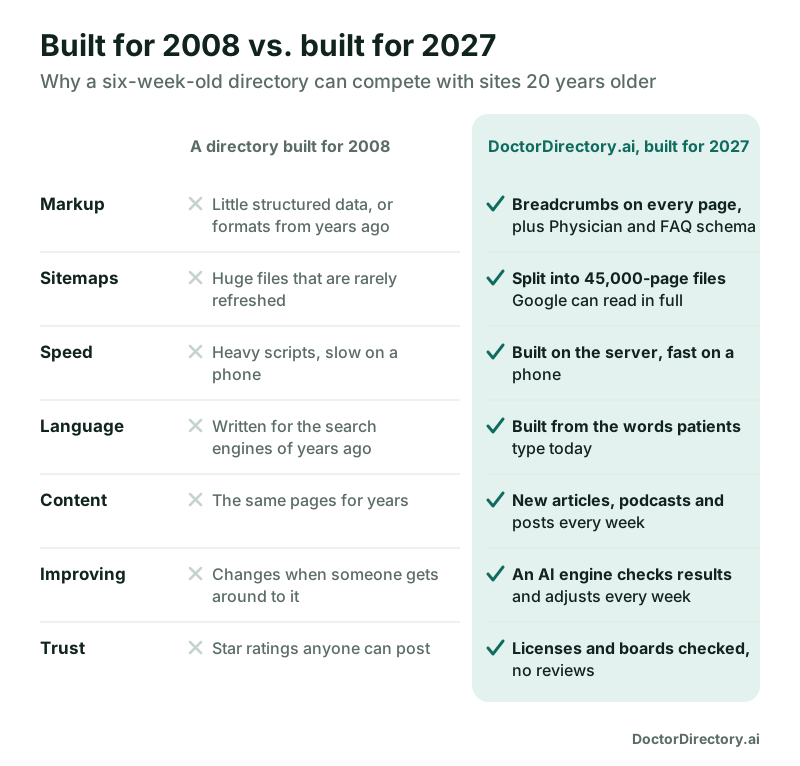
How we did it: six things working together
1. The right research
Before we built a page, we looked at what patients actually type into Google. Searches like "cardiologist near me," "menopause specialist Houston," and "lipidologist near me" tell you which pages to build and what to call them. We use Semrush and Search Console to find the real words patients use, then build pages around them.
2. The right structure
Every doctor gets their own page. Above those sit pages for each specialty, condition, state, and city, all linked together, so Google can see how the site fits together. We only ask Google to index a city or specialty page once it has enough real listings to be useful. Thin pages stay out.
3. The right markup
Markup, also called structured data, is a small block of code that tells Google what a page is about in its own language. Every profile carries breadcrumb markup that shows Google exactly where the page sits: specialty, state, city, then the doctor. Vetted profiles add full Physician markup with specialty, address, phone, services, and languages. Our articles carry markup for their common questions, too.
4. Fast, clean pages
Our pages are built on the server and load fast on a phone, where most patients search. Google can read every word without waiting on scripts.
5. Trust that Google can see
Google holds health pages to a higher standard. It looks for experience, expertise, authority, and trust. Every vetted listing on DoctorDirectory.ai is checked against the national license registry, every state medical board, court and FTC records, and the doctor's own public posts. Read how we vet. There are no patient reviews and no star ratings to game.
6. Marketing that never stops
DoctorDirectory.ai runs on DocFluence, an AI marketing system that publishes articles, podcast episodes, and social posts every week. It watches what ranks, learns from it, and keeps improving. Each new article links back into the directory, which helps Google find and trust the doctor pages.
What this means for doctors
If you are a licensed physician in the United States, you probably already have a profile on DoctorDirectory.ai. When a patient searches your name, that page may already be showing up. The question is what it says.
- Claim your profile for free. Add your photo, your practice details, and your own words. Check if you are listed.
- Get vetted. Vetting is free and cannot be bought. A vetted profile shows patients the checks you passed.
- Go Featured if you want more reach. Featured physicians appear first, 100% of the time, in a labeled block on every DoctorDirectory.ai page they match. See plans for physicians.
Google decides its own rankings, and no one can promise anyone a position. What we can show you is the work and the results so far: six weeks, and already 1,723 doctors on the first page.
For health systems and large groups
The same system can work for every physician in a health system: every doctor listed, the right markup, and steady content marketing for primary care and service lines. DocFluence offers it to enterprises. Request an enterprise quote.
Your next step
Want the playbook for your own practice? Read SEO for doctors in 2027, then claim your free profile.
Common questions
How did DoctorDirectory.ai get so many pages on Google's first page so fast?
By combining keyword research, a clear site structure, breadcrumb markup on every profile, Physician markup on vetted ones, fast pages, sitemaps Google can read, a vetting process that builds trust, and weekly content from DocFluence. No single trick did it. The pieces work together.
What does "first page" mean in these numbers?
It means the page had an average position of 10 or better in Google Search Console over the 28 days ending October 30, 2026. Most of those searches were for a doctor's own name.
Is my profile on the first page of Google?
Search your name and see. If your DoctorDirectory.ai profile shows up, claim it for free so it says what you want patients to read.
Can DoctorDirectory.ai guarantee my ranking?
No. Google decides rankings, and anyone who promises a position is not being straight with you. On DoctorDirectory.ai itself, Featured physicians always appear first on the pages they match.
Can a health system use the same approach?
Yes. DocFluence, the AI marketing system behind DoctorDirectory.ai, offers it to health systems and large groups. Visit docfluence.ai/enterprise to request a quote.