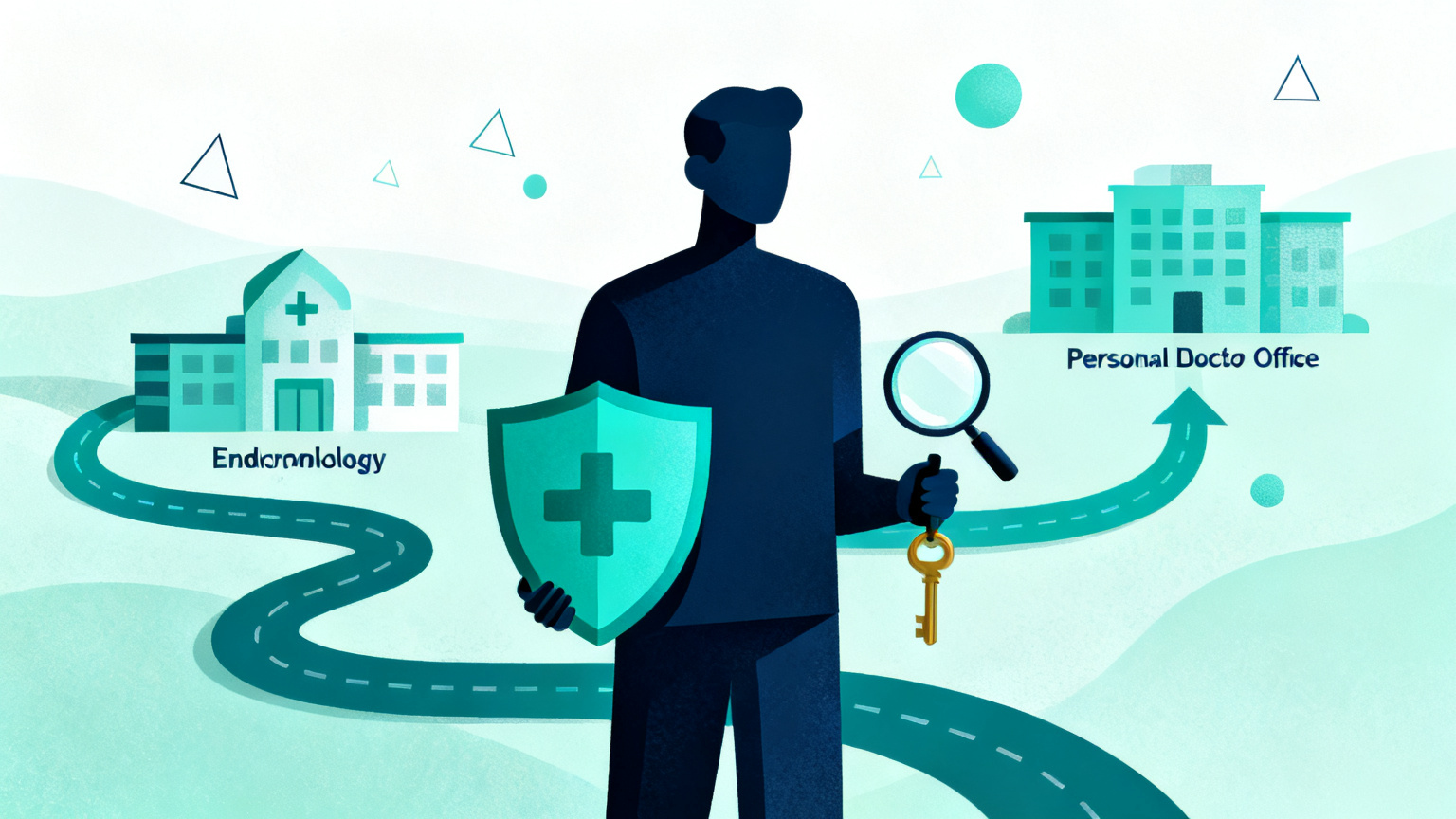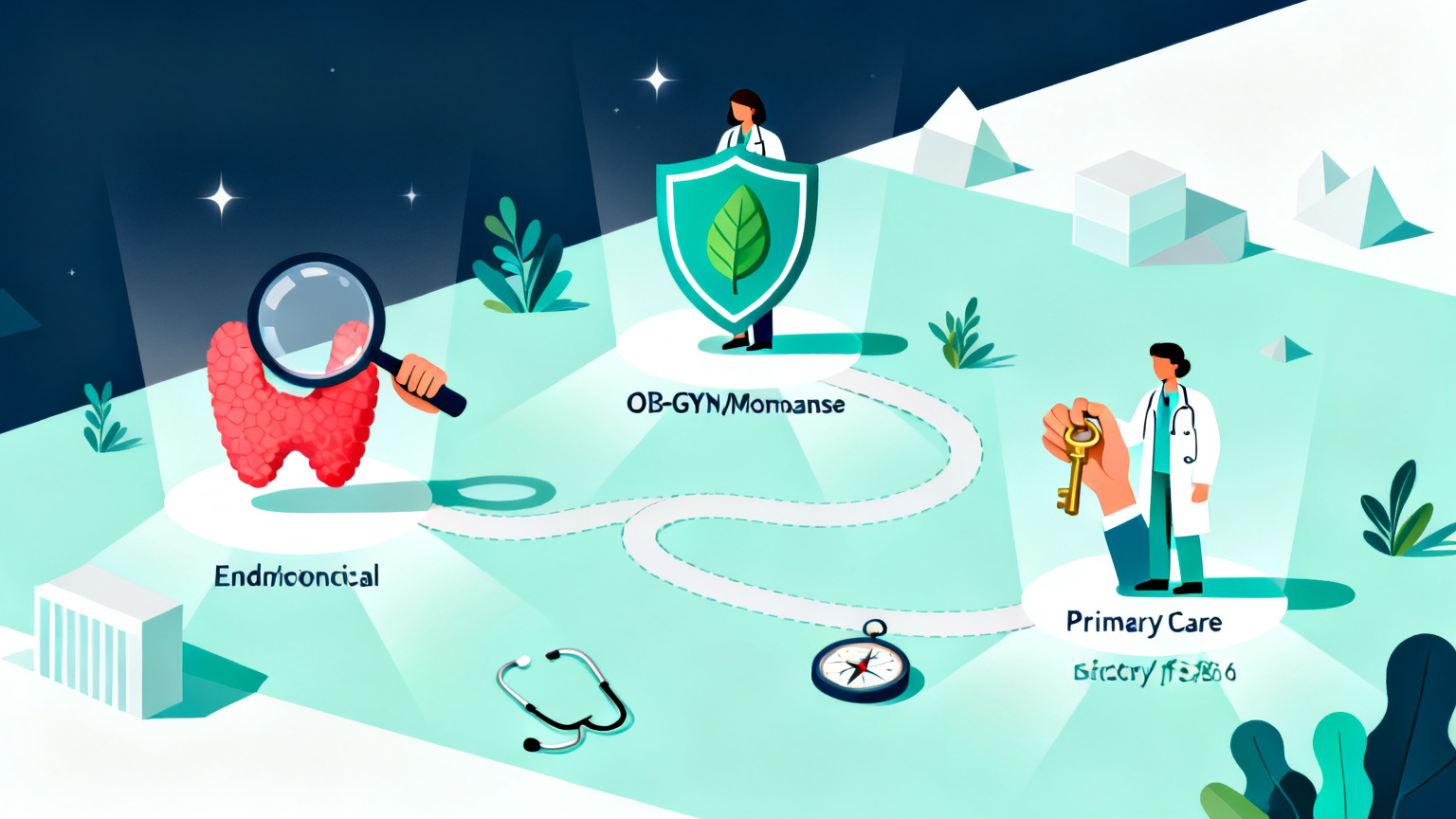
Who treats hormone problems: endocrinologist, OB-GYN, or your own doctor
"Hormone specialist" is not one job. Thyroid and adrenal problems go to an endocrinologist, menopause goes to a gynaecologist or a certified menopause clinician, and a good primary care doctor handles more of it than people expect.
There is no single hormone doctor
People search for a hormone specialist because they feel tired, gained weight, lost sleep, lost interest in things, or stopped feeling like themselves. Those symptoms are real and they deserve a proper answer.
The difficulty is that hormones are made in at least six different organs, and different specialists look after each one. There is no board certification in hormones. Going to the wrong clinician wastes months, and going to a clinic that advertises itself as a hormone specialist can waste money as well.
Here is how the work is actually divided.
The endocrinologist
An endocrinologist trained in internal medicine and then spent two or three more years on the glands. They are the right doctor for:
- Thyroid disease, including an overactive or underactive thyroid, nodules, and follow-up after thyroid cancer
- Diabetes that is hard to control, all type 1 diabetes, insulin pumps and continuous glucose monitors
- Adrenal problems, including Cushing's syndrome, Addison's disease and adrenal masses found by accident on a scan
- Pituitary tumors and the hormones they disturb, including prolactin and growth hormone
- Osteoporosis, calcium problems and overactive parathyroid glands
- Low testosterone where the cause needs working out rather than simply replacing
See our endocrinologists if any of those fit.
The gynaecologist or menopause clinician
Estrogen and progesterone through the reproductive years, and the change that comes with menopause, belong to gynaecology.
Hot flushes, night sweats, irregular or heavy periods, vaginal dryness, painful sex, urinary symptoms and the sleep disruption and mood change of perimenopause are all handled there.
Some clinicians hold an additional certification from The Menopause Society, meaning they sat an examination specifically on menopause care. That matters, because menopause gets strikingly little time in general medical training. Our menopause specialists list identifies them, and there is more detail in what menopause certification means.
Polycystic ovary syndrome sits on the border between the two. Either an endocrinologist or a gynaecologist can manage it well, and the right choice is usually whoever you can see sooner.
What your own doctor should handle
More than people expect. A good primary care doctor can diagnose and treat straightforward hypothyroidism, start and monitor levothyroxine, check testosterone correctly, manage most type 2 diabetes, prescribe menopause hormone therapy, and investigate fatigue properly before blaming a gland.
They should refer when the numbers do not match the symptoms, when a first treatment has not worked, when there is a nodule or a mass, when the person is pregnant or trying to be, or when the diagnosis would change management significantly.
If your doctor will not check a thyroid level when you have clear symptoms, that is a reason to get a second opinion, not a reason to buy a home hormone panel.
Which tests are actually useful
Useful, when there is a reason to order them: TSH, free T4, HbA1c, morning testosterone repeated on a second day, prolactin, cortisol at the right time of day, FSH in specific circumstances, vitamin D, and a full blood count and ferritin, because iron deficiency imitates almost every hormone complaint.
Rarely useful in routine care: reverse T3, which has no established clinical role, salivary hormone panels, wide unfocused hormone panels sold direct to consumers, and testing estrogen levels to titrate menopause treatment, which is guided by symptoms instead.
Timing matters more than most people realise. Testosterone is highest in the morning. Cortisol follows a daily rhythm. A result drawn at the wrong hour is not a result, it is noise.
A warning about hormone clinics
There is a large and profitable business built on hormone anxiety: compounded hormone pellets, testosterone for anyone who asks, thyroid medicine prescribed on symptoms while ignoring the blood test, and long supplement lists sold from the same office.
Compounded bioidentical hormone pellets are not approved by the Food and Drug Administration. The dose cannot be adjusted once the pellet is implanted, levels often run far above physiological range, and professional societies advise against them when an approved product exists.
No clinician on this directory sells supplements, peptides or compounded hormones. That is a condition of being listed, not a preference.
Questions worth asking at the first visit
- What are we testing, and what will each result change?
- If this is a hormone problem, what is causing it?
- What are the treatment options, including doing nothing for now?
- Do you prescribe compounded hormones or pellets? Why, or why not?
- Do you sell any supplements or products from this office?
Finding the right one
Every clinician in our endocrinologists list has had their license checked against the national registry, has their board certifications recorded, and has been screened against their public record. We show no patient reviews and no star ratings, and paying for a listing never changes who passes review.
Common questions
My hormone panel from an online company was abnormal. What now?
Take it to a clinician before acting on it. Direct-to-consumer panels often test hormones that are not clinically useful, at times of day that make the result meaningless. A repeat in a proper laboratory, at the right time, is the sensible next step.
Can I see an endocrinologist without a referral?
Some plans allow it, many do not, and most endocrinology practices want recent blood work before the visit. Starting with your primary care doctor usually gets you seen sooner, not later.
Is low testosterone an endocrinology or a urology problem?
Both see it. Endocrinology tends to work out why the level is low. Urology tends to be involved when fertility or the testicles themselves are the issue.
Could my symptoms be something other than hormones?
Very often. Anemia, iron deficiency, sleep apnoea, depression, celiac disease and simple sleep debt produce the same picture, and all are more common than most hormone disorders.
Are bioidentical hormones safer?
Body-identical hormones that are FDA approved are used routinely and are a reasonable choice. Compounded bioidentical preparations are a different thing: not reviewed for quality or dose consistency, and not recommended by guidelines when an approved option exists.
References
- Clinical practice guidelines, The Endocrine Society
- The 2022 hormone therapy position statement, The Menopause Society (2022)
- Guidelines for the treatment of hypothyroidism, American Thyroid Association
Why this matters
Good specialist care follows the guidelines. A directory that verifies that, rather than counting stars, changes who you end up in front of.
DoctorDirectory.ai is different on purpose. Every clinician is verified against the federal license registry, screened across their website, social accounts, board actions, and news, and signs a dated attestation to the major society guidelines that renews every year. Websites are re-checked monthly and listings are audited at random. Nothing a clinician or advertiser pays for changes who passes or who ranks. And there are no patient reviews to buy, bulk-post, or weaponize. That is what a vetted directory looks like, and it is what a healthcare system running low on trust needs more of.
For patients
Find the right doctor, then tell someone.
Search by condition and city. Every result is licensed, board-certified, and on record for evidence-based care. If a friend or family member is choosing a doctor, send them here before they read a single star rating. The more people who expect this standard, the more clinicians will meet it.
For clinicians and the medical community
Vetting and guardrails are how we earn trust back.
A license proves training. It does not tell a patient who sells peptides, who tells families to skip vaccines, or who quietly lost a license in another state. Directories that verify, attest, re-check, and remove are the guardrails the profession has been missing. If you practice from the evidence, put your name to it where patients can see it, and ask your colleagues to do the same.